Grade or classHistory Foundation: Reading world history
- What your child learns
- Students who read English books but lack background knowledge read world history in order, from ancient civilizations to today, and write about it.

Your child reads English texts on history, society, and economics and uses evidence to say and write what they think.
Your child reads world history era by era, then answers history questions with evidence, in writing that grows from a single paragraph to a long history essay.
*Hover over or tap a card to see the details and its link.
Students who can read English books but lack the background knowledge and evidence for essays and debates read world history era by era.
What your child works on: Your child lays out the causes and effects of events in ancient Egypt, Mesopotamia, Greek democracy, and the Roman Empire, and writes answers to questions.
What your child works on: Your child looks at how religion and power were tied together and how society changed.
What your child works on: Your child compares the background, structure, and lasting impact of the American, French, and Industrial Revolutions.
What your child works on: Your child learns about the world wars and modern history and compares them with problems in society today.
What your child works on: Your child writes an essay comparing two eras or events, rebuts the opposing argument with evidence, then takes part in a final debate and gives a presentation.
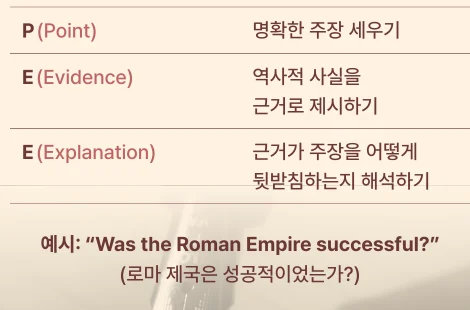
For a question like "Was the Roman Empire successful?", your child writes their own view (Point), historical facts (Evidence), and an explanation that connects the two (Explanation).
A rubric assesses two areas, Knowing and Understanding and Investigating, and you receive the results in a History Report.
Students who finish the advanced activities can go on to prepare for the John Locke Institute Essay Competition, Model UN (MUN) debates, or the IB Extended Essay (the IB research paper).
A one-on-one class for students ages 9–12 who read at a high level in English and ask "why?" a lot, but need practice turning their thoughts into logical writing.
A reading and writing test before the class sets the length and difficulty of the writing, and students who are ready go on to write history essays of 600–1,000 words.
Early civilizations, Greece, Alexander, Rome: "Why do civilizations rise and fall?" "Why did Rome fall?"
World religions, the Silk Road, the Mongols, the Black Death: "Were the Mongols destroyers, or did they connect the world?"
The Renaissance, the Age of Exploration, Columbus: "Was Columbus an explorer or a conqueror?"
The Enlightenment, revolutions, the Industrial Revolution, imperialism: "Did the Industrial Revolution make life better?"
World Wars I and II and the atomic age: "Could World War I have been prevented?"
Your child turns the research into a paper, documentary, exhibit, or presentation and adds it to their portfolio. Students who are ready can go on to NHD (National History Day)–style research or argumentative essay competitions like the John Locke Institute Essay Competition.
| Book or material | What your child learns from it |
|---|---|
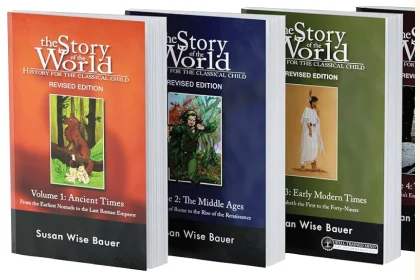
| A Little History of the World (E. H. Gombrich) | Your child reads it at home every week to get the big picture of world history. |
| Historical Evidence Pack (sources compiled for class) | The core class material: primary and secondary sources, maps, speeches, and photos chosen for each question and adapted to your child's level. |
| Reading Like a Historian (a history reading curriculum from the US Digital Inquiry Group) | Your child uses it to practice comparing several sources and judging which argument is more convincing. |
| Supplementary reading | Your child also reads Horrible Histories, The Story of Science, the Who Was? / What Was? series, Steve Sheinkin's Bomb, and other books chosen to match each topic. |
Primary sources are records made at the time of an event; secondary sources are later writing by people who studied it.
Your child reads the chapter on Alexander in Gombrich's A Little History of the World before class.
Your child reads a map and two or three short primary sources and compares the Greek view with that of the Persians and the people Alexander conquered.
Your child sorts evidence on the scale of conquest, spread of culture, destruction of cities, and treatment of local people into for and against columns.
Your child first acknowledges what's fair in the other side's view, then writes in Claim, Evidence, Reasoning order.
Grade levels and course names can vary by school.
*Click to expand the details.
| What to settle | Details |
|---|---|
| Reading and homework | Which books your child reads at home each week, and how much homework there is |
| Number of classes | Whether to add the advanced activities after the History Foundation regular course, and the total number of classes |




Comparing school social studies in grades 1–5