

Middle School (G7–9)
Middle school classes include Write Lab, where your child writes English essays and analytical pieces; Math Lab, where they practice Korean-curriculum math with problems written in English as well; and science, social studies, and Korean classes that follow what they're covering at school. Find the classes that fit your child, then request a consultation.
If this sounds like your child
Pick the concern closest to what you're seeing now.
*Click to jump to that section.
- I want to know where my child stands first.A diagnostic assessment shows which units your child has already learned in each subject and which concepts they haven't mastered yet.
- My child has trouble building a claim and evidence in English essays.In grades 6–7, your child writes paragraphs with a claim and evidence. In grades 8–9, they compare several English sources to choose evidence.
- My child gets stuck on math word problems or written-answer questions in English.Your child learns Korean math concepts with English terms, turns the conditions in each problem into an equation, and writes out why the solution works.
- School math is fine, but my child wants harder problems.In Math Lab, your child moves on to competition problems like AMC 8 and 10 and sample IGCSE exam questions.
- I'm worried about my child's school science, social studies, or Korean classes.In science, social studies, and Korean, we choose which units to study based on what's on the next school test.
- My child wants to read and critique books in depth, or we'd like career and admissions advice.In Critical Book Club, your child critiques advanced books in English. In consulting, we map out your child's school admissions plan with you one-on-one.
Write Lab
Write Lab: English Writing
Your child learns English reading, grammar, and writing together. We set their starting level based on how they write in English now.
- K–G1Telling stories through language playLanguage Play & Story Foundations
- G2–3Writing stories from experience and imaginationCreative Writing
- G4–5Organizing information to explain a topicInformative Writing
- G6–7Essays with a claim and evidenceAcademic WritingMiddle school
- G8–9Analytical writing that compares sourcesPrep AP - IB Analogical WritingMiddle school
- G10–11Research papers and college application essaysCollege Prep-Advanced Writing
G6–7: Building a claim and evidence in one paragraph
- Write a one-sentence claim that answers the question
- Put reasons, evidence, and examples in order in a paragraph
- Pick only the information the claim needs from English sources
G8–9: Comparing several sources to choose evidence
- Compare what each source on the same topic argues
- Choose evidence that's relevant to the question and trustworthy
- Keep what came from a source apart from their own ideas, and cite the source
Writing a full piece in English, from plan to rewrite
- Choose the writing question and the sources to read
- Compare the sources and pick evidence
- Draft in claim-then-evidence order
- Revise with the instructor's feedback
Skills your child practices alongside essay writing
Read English sources on social studies and science
Your child reads English sources on topics like world history, economics, global issues, biology, and astronomy and uses them as evidence.
Sharpen vocabulary and grammar
Your child picks words in analogy and sentence-completion questions and fixes their own paragraphs with the grammar they learned.
Cite and quote sources
In grades 8–9, your child finds the question, evidence, and conclusion in news articles and research writing and quotes them with sources.
Math Lab
Math Lab: Middle School Math
Your child first builds a solid grasp of Korean math concepts, then learns the same units with the English terms and problems of US, UK, and IB math.
Korean curriculum, G7–9
- G7–8: integers and rational numbers, expressions
- G7–8: linear equations and functions, basic geometry
- G9: quadratic equations and functions
- G9: trigonometric ratios, basic statistics
International courses, G7–9
- G7–8: Pre-Algebra · Algebra 1
- G7–8: KS3 Math
- G9: Algebra 2 · Geometry
- G9: GCSE Higher Tier · quadratic functions, geometry, and statistics in IB MYP
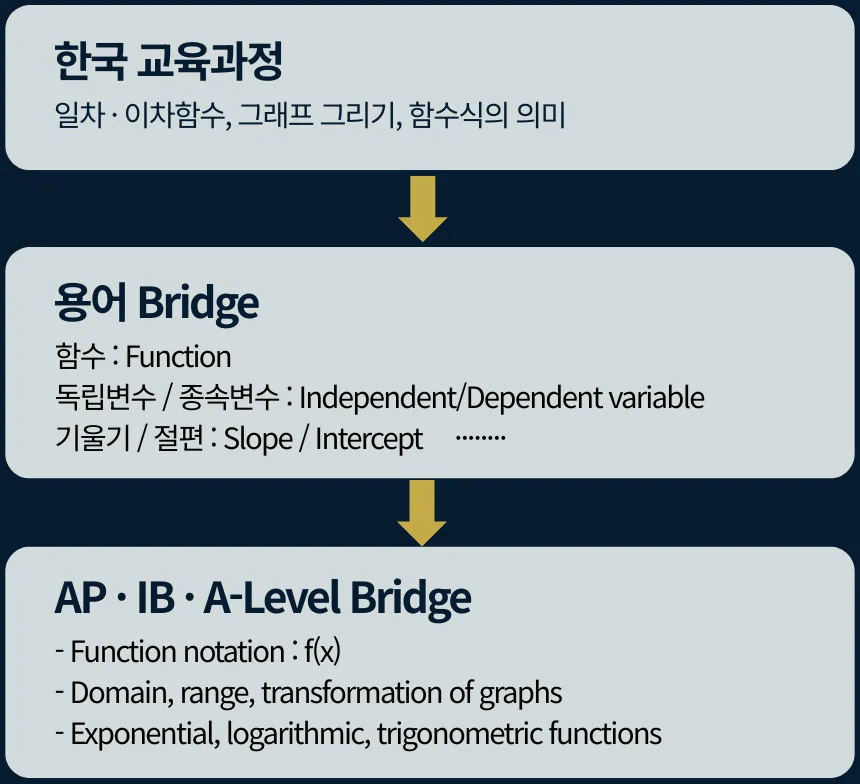
The functions unit, from the Korean textbook to high school courses
Your child relearns the functions from their textbook with English terms, then goes on to high school function notation and graph transformations.
Your child solves problems on their own and redoes the ones they got wrong
Explain why they set up each equation
In equations, functions, and the angles and areas of shapes, your child explains in words and writing why they set up the equation and which shape property applies.
Solve English word problems
Your child reads long word problems in English, finds the conditions, and turns them into equations.
Redo problems they got wrong
Your child finds why they got a problem wrong, fixes their concept notes, and redoes the same type until they can solve it without help.
Solve competition and international exam problems
Once your child can handle school math alone, grades 7–8 solve AMC 8 and 10 problems, and Grade 9 solves AMC 10 and sample IGCSE questions.
What your child learns in each subject
Each subject covers different middle school material and is taught in its own way.
Math
Korean middle school math for grades 7–9, plus US, UK, and IB middle school math
Your child practices writing out solutions in the format school tests use for written-answer questions.
See math concepts by gradeEnglish
School English essays, literary analysis, research writing, and presentations
Your child compares several English sources to build a claim and evidence, then uses them in school essays and presentations.
See English classes for international school studentsScience
Earth systems, cells and genetics, basic chemistry, physics, the human body
Your child reads graphs, tables, and experiment results and explains causes and effects in science terms.
See middle school scienceSocial Studies & History
Ancient civilizations and geography, civics and world history, modern history and global issues
Your child compares several sources, picks evidence, and writes their own view in discussions and essays.
See middle school social studies and historyKorean
Nonfiction reasoning, literary interpretation, grammar, school exams, and written-answer questions
Your child checks the basics with textbooks and school class materials, then practices with unfamiliar passages and written-answer questions.
See middle school Korean
Students in IB programs such as the MYP can also take LABCO IB Support, a one-on-one online class where they review with school assignments and assessment materials and prepare for assessments.
See classes that use IB school materialsFind your child's school subjects in grades 6–9
This is what students usually learn each year in the US, IB, UK, and Korean curricula. The grade and course name can vary by school.
*Click to change the content below.
| Grade | US | IB | UK | Korean curriculum |
|---|---|---|---|---|
| G6 | Ratios, expressions, equations | MYP Mathematics | KS3 fractions, algebra | - |
| G7 | Pre-Algebra, proportional reasoning | MYP Mathematics | Algebra, number, ratio | G7–8: integers and rational numbers, expressions, linear equations and functions, basic geometry |
| G8 | Algebra 1, functions | MYP Mathematics | Algebra, geometry | G7–8: integers and rational numbers, expressions, linear equations and functions, basic geometry |
| G9 | Pre-AP Algebra 2, Geometry | Pre-IB Math | IGCSE Math | Math I basics (an early start on a Korean high school course) |
| Grade | US | IB | UK | Korean curriculum |
|---|---|---|---|---|
| G6 | Earth systems, cells | MYP Integrated Science | KS3 biology, chemistry, physics | - |
| G7 | Genetics, basic chemistry | MYP Integrated Science | KS3 Science | - |
| G8 | Physical science, the human body | MYP Integrated Science | Final KS3 units | - |
| G9 | Pre-AP Biology, Chemistry | General Science | IGCSE Combined Science | Integrated Science |
| Grade | US | IB | UK | Korean curriculum |
|---|---|---|---|---|
| G6 | Argument, literary elements | MYP Language & Literature | Reading, grammar | - |
| G7 | Literary analysis, research writing | MYP Language & Literature | Fiction, nonfiction | - |
| G8 | Rhetorical writing, speeches | MYP Language & Literature | Persuasion, poetry | - |
| G9 | Pre-AP English | Pre-IB English | IGCSE English | Grammar, reading, school exam prep |
How your child's G7–9 class plan takes shape
Students at international schools and Korean schools start the same way.
Tell us about their school subjects
Tell us your child's grade, their school curriculum (US, IB MYP, UK, or Korean), and the subjects you're worried about.
Plan from the diagnostic results
We compare diagnostic assessment results with what your child is covering at school and set a class plan for each subject.
Adjust the plan with assessment results
Each end-of-month assessment and the quarterly MAP Test show which units to review and how far to go next.
We share assessment results with you regularly.
See how parents get progress updatesG7–9 special programs
Beyond Write Lab and Math Lab, your child can sign up for a class where students critique books in English, and for academic, career, and admissions consulting.
Students in Grade 7 and up
Critical Book Club
Your child reads and critiques advanced literature and nonfiction on social and philosophical topics, then writes and presents in English.
See Critical Book ClubStudents in all grades, K–12, and their parents
Academic, Career & Admissions Consulting
We build a long-term academic plan one-on-one around goals like a Korean gifted or science high school, international school grades, or college abroad.
See Academic, Career & Admissions Consulting
Plan your child's G7–9 classes
Tell us which subjects your child takes at school and what they're aiming for, and we'll find the middle school classes that fit.