A chalkboard filled with equations and graphs

Math

Your child solves English-language problems on the math concepts they learned in Korean school and practices explaining why each solution works.

Grades 1–6 cover operations, fractions, and ratios; grades 7–9 cover equations, functions, and geometry; grades 10–11 cover the Korean high school courses Common Math, Algebra, and Calculus. At every level, your child works with English math terms and word problems too.

Math classes at a glance

Math classes to choose from

*Click to jump to that section.

  • ClassMath Lab: math by grade

    What your child learns
    Your child learns Korean school concepts for their grade, then uses English math terms to solve word problems on the same concepts.

  • ClassCourse order by curriculum

    What your child learns
    Your child follows the course order of their own school, whether that's AP, A Level, IB, or Korean math.
  • ClassElite Math: advanced classes

    What your child learns
    From Pre-Algebra to Calculus and competitions, your child learns to read English word problems and build mathematical arguments.
  • ClassInternational math by goal

    What your child learns
    Your child studies the content and textbooks that match their goal: school grades, a math competition, or a gifted math camp.

Learning steps and assessments

From Korean school concepts to English problems, step by step

Steps your child already understands get a quick check, and lessons start at the step they need.

At this step, your child

  1. StepReview Korean school concepts and key problem types
    At this step, your child
    Works through the concepts and key problem types from Korean school again.
  2. StepLearn English math terms
    At this step, your child
    Learns the English math terms for the same concepts.
  3. StepSolve English word problems
    At this step, your child
    Finds the conditions in English word problems and sets up equations.
  4. StepWrite out the reasoning: PEE and PEEL
    At this step, your child
    Writes their reasoning as a PEE answer (Point–Evidence–Explanation). In PEEL, they add a Link sentence.
  5. StepApply it to AP, IB, A Level, and competition problems
    At this step, your child
    Uses the same concept to solve AP, IB, A Level, and competition problems.
Functions unit example: Korean concepts and English course terms

Korean school concepts

  • Linear and quadratic functions
  • Drawing graphs
  • What a function's equation means

English terms and AP, IB, and A Level notation

  • Function, Independent Variable, Dependent Variable
  • Slope, Intercept
  • Function notation f(x), Domain, Range, Graph Transformation
  • Exponential Function, Logarithmic Function, Trigonometric Function

How your child learns one unit, step by step

Students do extra problems on the types where they get stuck.

Five steps for working through a unit: concept check, core problem types, applications, advanced problems, and a final check
  1. Step: Concept check

    At this step, your child: Goes over the last assignment and problems they got wrong, then checks key concepts with questions and a quiz.

  2. Step: Core problem types

    At this step, your child: Applies the concept to representative examples.

  3. Step: Applications

    At this step, your child: Uses the same concept on problems with changed conditions.

  4. Step: Advanced problems

    At this step, your child: Solves challenge and proof problems at their level.

  5. Step: Final check

    At this step, your child: Finishes the unit with a quiz that shows whether they understood it.

Quiz results and what your child is covering at school decide how much of the next class goes to review and how much to challenge problems.

Redoing problems they got wrong

  1. Solve the problems they need from the problem bankProblem Bank
  2. Find the problem types they often get wrong, and whyError Analysis
  3. Fix their concept notes and solve againRe-Practice
  4. Solve without help and explain the solutionMastery Check

After getting the right answer, your child explains the solution and proves it

Four solution-writing skills: finding the answer, explaining why the method works, writing the reason for each step, and proving the solution
  1. Step: Answer: Find the answer

    At this step, your child: Reads the conditions, sets up an equation, and solves it.

  2. Step: Reason: Explain why they chose that method

    At this step, your child: Answers in their own words when the instructor asks, "Why did you pick this method?"

  3. Step: Justify: Write the reason behind each step

    At this step, your child: Answers "Why does this equation hold?" and writes the reason for each step.

  4. Step: Prove: Write the whole solution as a complete proof

    At this step, your child: Writes the proof from start to finish in logical order.
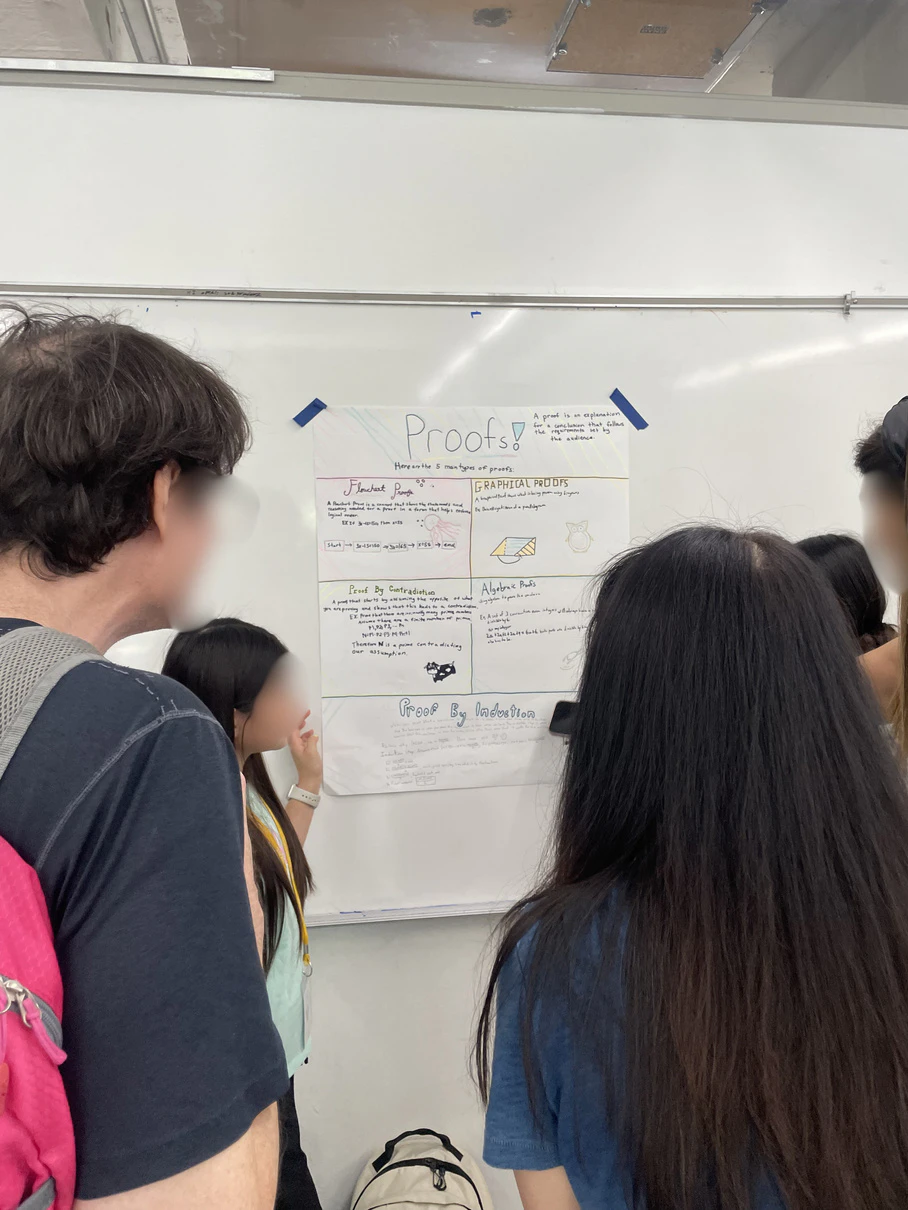
Filling concept gaps at your child's level

What students learn

  • AreaK–G1 and G1–6 math
    What students learn
    Students learn number sense and operations, fractions and decimals, ratios and measurement, shapes, and reading data, working on the problem types that come up most often.
  • AreaPre-Algebra, KS3, algebra, geometry
    What students learn
    Students learn numbers and proportion, equations and functions, and shapes, derive formulas themselves, then solve basic, applied, and challenge problems.
  • AreaSchool math and test prep
    What students learn
    Students work on school concepts alongside practice test problems, and redo the problem types they got wrong after hearing the explanation.

Each child gets the mix of Main (core lessons), Gap-Repair (filling concept gaps), and Challenge (harder problems) that fits them.

Textbooks and assessments

We choose textbooks based on your child's current level and goals.

Details

  • ItemTextbooks
    Details
    Students use Math Fundamentals, CGP, AoPS, Pre-Algebra textbooks, and math dictionaries.
  • ItemNotes on concepts and mistakes
    Details
    Students record concepts, terms, and formulas along with their work, scores, and corrections, and keep it all in their own portfolio.
  • ItemAssessments
    Details
    A quiz every class and an end-of-month assessment show whether your child understood each unit. See how parents get progress updates

Sample textbooks used in class

AoPS (The Art of Problem Solving) textbooks come one per topic, such as Pre-Algebra, counting and probability, and algebra. Students use them in advanced classes and competition prep.
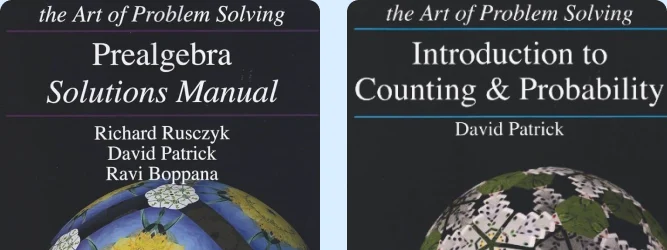
Covers of the Art of Problem Solving books Prealgebra Solutions Manual and Introduction to Counting & Probability
Sample AoPS book covers: Prealgebra Solutions Manual and Introduction to Counting & Probability

Math classes by curriculum and goal

Math course order in each curriculum

US (AP), UK (A Level), IB, and Korean schools each teach math courses in a different order.

Typical course order for AP, A Level, IB, and Korean math, with the tests and topics studied alongside
  • Curriculum: AP

    Course orderPre-Algebra → Algebra 1/2 → Geometry → Pre-Calculus → AP Calculus AB/BC·AP Statistics

    Tests and topics studied alongsideSAT/ACT Math, AMC, MathCounts, AIME

  • Curriculum: A Level

    Course orderKS3/IGCSE (Year 7–9) → GCSE/IGCSE → AS/A Level Mathematics & Further Mathematics

    Tests and topics studied alongsideAlgebraic manipulation, proof, functions, calculus, mechanics, statistics

  • Curriculum: IB

    Course orderMYP Math Grade 6–10 → DP Mathematics AA/AI SL/HL

    Tests and topics studied alongsideIdeas for the Internal Assessment (IA) and the math modeling that investigation projects call for

  • Curriculum: Korean math

    Course orderSchool exams and written-answer problems in elementary, middle, and high school → CSAT (Korea's college entrance exam) and school-exam problems with written logical solutions

    Tests and topics studied alongsideSchool exam and CSAT problems, from basic to advanced

Elite Math: Advanced English Word Problems and Mathematical Reasoning

From students who get stuck on English word problems to students preparing for competitions, Elite Math goes deep on reading word problems and building mathematical arguments.

The four Elite Math levels, Foundation, Core, Elite, and Competition, with what each level covers
  1. Level: Foundation

    What it covers: Pre-Algebra

  2. Level: Core

    What it covers: Algebra I/II, Geometry

  3. Level: Elite

    What it covers: Pre-Calculus, Calculus

  4. Level: Competition

    What it covers: AMC 8/10/12, UKMT, Math Kangaroo

Math Language Comprehension: Turning English text into equations

Students find the hidden conditions and variables in long English passages and turn them into equations.

Advanced Logical Reasoning: Proving why a solution works

Students work out why a formula holds and prove their solution out loud in English (Oral Proof).

Strategic Thinking: Solving a problem more than one way

Students solve unfamiliar problems several ways, then choose the most efficient solution themselves.

International math classes by goal

What your child learns and which textbooks they use depend on the goal: school grades, math competitions, or a gifted math camp.

International math classes by goal
GoalWhat your child learns and works onTextbooks and materials
School gradesMastering school courses and working ahead, English Word Problems, SSAT/SAT MathAoPS, Math Fundamentals, MathCounts, Beast Academy, our own materials, and school textbooks
Math competitionsAMC and UKMT prep, proofs, advanced topics, problem-solving strategies, timed mock testsMath Competitions, Mastering AMC, past papers, and our own materials
Gifted math camp prepProof Writing, written corrections on math solution essays, a portfolioHow to Solve It, The Art and Craft of Problem Solving, Mathematical Circles, A Mathematician’s Lament
GoalSchool grades
What your child learns and works on
Mastering school courses and working ahead, English Word Problems, SSAT/SAT Math
Textbooks and materials
AoPS, Math Fundamentals, MathCounts, Beast Academy, our own materials, and school textbooks
GoalMath competitions
What your child learns and works on
AMC and UKMT prep, proofs, advanced topics, problem-solving strategies, timed mock tests
Textbooks and materials
Math Competitions, Mastering AMC, past papers, and our own materials
GoalGifted math camp prep
What your child learns and works on
Proof Writing, written corrections on math solution essays, a portfolio
Textbooks and materials
How to Solve It, The Art and Craft of Problem Solving, Mathematical Circles, A Mathematician’s Lament

Students learn the theory and proofs first, then solve problem sets.

Steps in gifted math camp prep

  1. Learn the logic and reasoning a solution calls for
  2. Solve timed competition problems
  3. Write proofs and math solution essaysProof Writing
  4. Write a personal statement for applicationsPersonal Statement
  5. Do independent research through a math journal or project

Your child can take only the steps they need, based on their goal and how ready they are.

Math classes for international and Korean school students

International school students prepare for their school classes and tests. Korean school students prepare for school exams and the CSAT.

What students prepare for at each kind of school

International schools

  • Prepare for school lessons, quizzes, and assignments, and get written corrections on school test answers
  • Take MAP and SAT/ACT Math mock tests to find weak spots and study them again

Korean schools (school exams and CSAT)

  • Study the next concepts and advanced theory ahead of school
  • Relearn weak units from the basics
  • Focus on calculation and geometry problems
  • Solve the key problems in each unit of one book several times
  • Practice explaining solutions in writing
  • Think through unfamiliar advanced problems for a long time before reading the answer key

Math Lab by school level

Enrollment

What we'll go over in consultation

What we'll go over in consultation
What to settleDetails
Diagnostic assessment and starting unitHow the diagnostic assessment works, which concepts your child should know first, and the unit to start with
Homework and next stepsHow much homework there is and what it takes to move to the next level

Plan your child's Math Lab classes

Tell us your child's grade, school curriculum, the units they've covered, and the problems they find hard to solve alone. We'll choose the starting unit together.