G10–11Korean high school courses: Common Math 1 and 2, Algebra, CalculusPre-Calculus and beyond ·A-Level Math (AS) · BP Math AA/AI (SL/HLCore)
*Hover over or tap a card to see the details and its link.
GradeG7–8
What your child learns
Integers and rational numbers, variables and expressions, linear equations and functions, and basic geometry. Students also solve AMC 8 and AMC 10 problems.
Your child learns the concepts from the Korean textbook first, then works through the same unit again with English terms and English problems.
What your child studies at each step
01Learn the concept from the textbook
02Learn the same concept with English termsFunction ·Slope · Intercept
03Read English word problems and set up equationsWord Problems
04Write out the reasoning behind the solution
05Solve problems from international courses and competitions
Example: a word problem with a system of equations
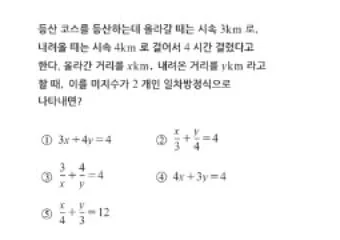
When a problem gives the speed going up and down a trail and the total time, your child lets x be the distance up and y the distance down and writes a linear equation. English word problems are set up the same way.
A Korean middle school word problem: choose the linear equation in two unknowns from the answer choices
Derive the formulas, then redo mistakes
We choose from Korean textbooks and school materials and from English Algebra and Geometry textbooks, based on your child's current unit, target course, and how well they read word problems in English.
Four kinds of middle school math practice: deriving formulas, going from basic to challenge problems, redoing problems they got wrong, and filling in earlier concepts
What your child practices: Deriving formulas
How it works: Your child works out where the formulas for equations, functions, and the angles and areas of shapes come from, and proves them.
What your child practices: From basic to challenge problems
How it works: Problems step up from basic to applied and challenge problems, with algebra and geometry mixed together.
What your child practices: Redoing problems they got wrong
How it works: Your child finds the concept that tripped them up, hears it explained, and redoes similar problems until they can solve them without help.
What your child practices: Filling in earlier concepts
How it works: If your child didn't fully learn a concept from an earlier grade, they go back to that unit and fill the gap first.
Your child writes out reasoning in this order
01Find the answerANSWER
02Explain why they chose that methodREASON
03Write the reason behind each stepJUSTIFY
04Write the whole solution as a complete proofPROVE
Tell us which math course your child takes at school, which units they've covered, and which problem types give them trouble. We'll choose the starting unit together.