ClassWrite Lab: English writing
- What your child learns
- From kindergarten through Grade 11, your child writes stories, explanatory pieces, and essays in English.

Your child reads and understands English texts, then backs up their own ideas with evidence when they speak and write.
From kindergarten through Grade 3, your child writes English stories; in grades 4–5, explanatory pieces; and in grades 6–11, essays, analytical writing, and research papers.
*Click to jump to that section.
Your child's starting level depends less on grade than on the level they can write at now, judged from the books they read and their recent writing.
*Hover over or tap a card to see the details and its link.
Students in grades 2–5 put the phrases they've learned to use in essays, debates, and MUN (Model United Nations) Warm-Up. Students in grades 6–11 prepare for TOEFL Writing, research papers, and Common App essays.
At this step, your child: Goes over homework, assigned reading, and what they got wrong last time through questions or a quiz.
At this step, your child: Learns how words relate and how grammar works, then studies model writing to see how sentences and paragraphs fit the reader and purpose.
At this step, your child: Chooses a form (description, narrative, explanation, or persuasion) and maps out the order with brainstorming or a mind map.
At this step, your child: Writes the piece, then shows what they learned through questions, workbook problems, written answers, and discussion.
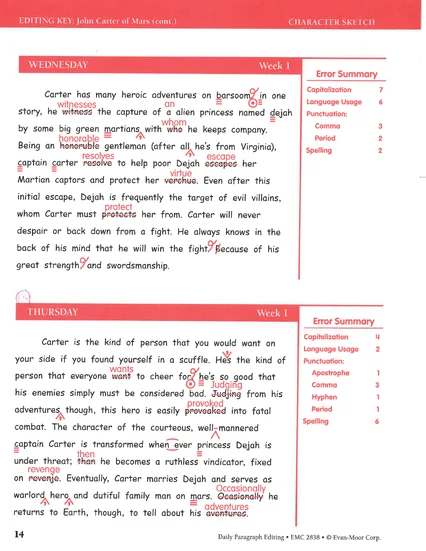
At this step, your child: Fixes sentences and paragraphs based on the instructor's corrections, then rewrites the piece.
The instructor sets the pace of the next class and the balance of review and harder work based on how well your child understood and what they're covering at school.
Reading
Writing
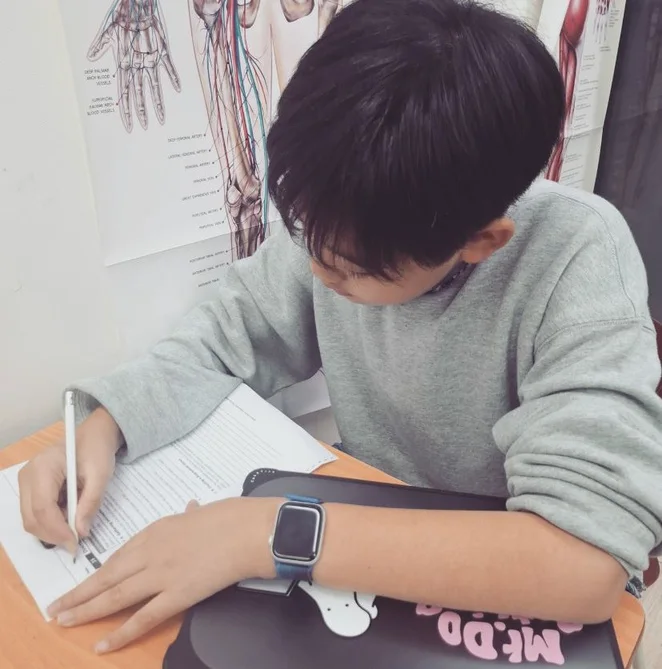
Your child's classes add practice in whichever area they're weakest in: vocabulary and grammar (Structure), background knowledge (Contents), or citing sources (Application).
Practice materials: Analogies ·
What your child practices: Works out how words relate and completes sentences with the word that fits the context.
Practice materials: Writing Models
What your child practices: Reads model writing and tries its form, logical structure, and key techniques in their own writing.
Practice materials: Grammar in Use ·
What your child practices: Writes sentences with the grammar they've learned, then finds and fixes errors in paragraphs.
Practice materials: Human geography, psychology, economics, world history, US history, European history
What your child practices: Reads and asks questions about social studies texts to build background knowledge for writing.
Practice materials: Biology, chemistry, physics, environmental science
What your child practices: Reads about science concepts and phenomena, explains them in English, and finds material to write about.
Practice materials: Reference & Citation
What your child practices: Learns how to choose sources for their writing and quote them with proper citations.
Practice materials: Current Affairs
What your child practices: Reads and analyzes articles on social issues and works out their own view.
Practice materials: Research Article Analysis
What your child practices: Finds and reads research papers, sums up the research question, evidence, and conclusions, and uses them in their own writing.
The MAP test also asks about how words and sentences relate and about inference, so your child practices these skills too.
In Write Lab, your child reads English texts on social studies and science topics and writes explanatory pieces from them, with topics matched to their English level.
| Grade | Social studies topics | Science topics |
|---|---|---|
| K–G1 | Family and community, jobs, rules, holidays | Plants and animals, seasons, the five senses, weather |
| G2–3 | Maps and geography, world cultures, famous people, goods and services | Habitats, life cycles, states of matter, the solar system |
| G4–5 | Ancient civilizations, basics of government, intro to US history, trade | Earth science, energy and forces, organs of the human body, ecosystems |
| G6–7 | World history, citizenship and rights, economic systems, conflict and cooperation | Basics of physics and chemistry, cells and genetics, the environment |
| G8–9 | Modern history, macro- and microeconomics, global issues, intro to psychology | Advanced biology, environmental science, astronomy, technology and ethics |
| G10–11 | Philosophy and ethics, political science, sociology, advanced economics | Advanced topics related to a future major, such as neuroscience, basic quantum mechanics, and AI technology |
Item · Details
Details
Students at British, American, and IB schools write English answers that address what literature, history, science, and social studies questions ask.
What your child practices: Works out whether the question asks them to explain or to make a judgment.
What your child practices: Decides the main point the answer will make.
What your child practices: Picks material from the reading that supports the claim.
What your child practices: Puts the evidence and explanation in order and writes the answer.
Your child uses the same steps to choose sources for research papers and writing competitions.
| Subject or curriculum | Answers practiced |
|---|---|
| English | Literary analysis and essays |
| History and humanities | Evidence-based arguments built on facts and sources |
| Science | Explanations of concepts and phenomena, and scientific writing |
| IB subjects | Analysis and evaluation answers, and extended responses |
| AP subjects | Free-response questions (FRQs) and evidence-based responses |
At this step, your child: Studies structure guides, writing frames, model writing, and grading criteria to learn how a strong answer is built.
At this step, your child: Uses that structure in their own assignments.
At this step, your child: Uses it again and again across assignments until organizing a piece comes naturally.
At this step, your child: Reads a question and decides on the evidence and structure without help.
A native English-speaking instructor assesses your child's work. Weak spots get covered again in the next class, and where your child is strong, they move on to harder assignments.
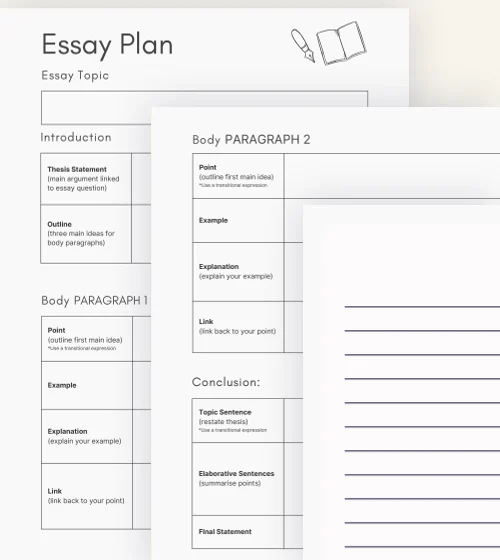
As at school, your child learns writing, reading, grammar, and vocabulary together.
Your child reads texts one level above their current reading level.
Your child writes essays with a claim, evidence, and a counterargument.
The instructor corrects each essay individually and assesses it against Cambridge and IELTS rubrics.
Your child also prepares school essays, presentations, and entries for the John Locke Institute Essay Competition.
We choose your child's class and books by looking at both their grade and their current reading level.
Reading logs and writing go into your child's portfolio and are used to prepare essays, research projects, and research papers.
*Click to expand the details.
For students in grades 9–10 who know grammar and vocabulary but struggle to turn their thinking into logical writing. They learn the writing basics needed for graded school assignments, AP, IB, A Level, IELTS Academic Writing, and essays for colleges abroad.
What students learn: Separates claim, reason, and evidence; tells fact from opinion; weighs bias and counterarguments; and writes concise sentences.
What students learn: Writes paragraphs with a topic sentence, evidence, and a concluding sentence, then a full essay with an introduction, body, and conclusion, and gets individual written corrections.
What students learn: Writes source-based argument essays within a time limit and completes a final essay and portfolio.
Your child decides which evidence best supports a claim and builds background knowledge by reading in social studies, science, economics, and philosophy.
Your child writes, gets written corrections, and revises. The instructor points out weak spots in sentence structure, logical flow, use of evidence, and wording, and shows how to fix them.
For students preparing for MAP, SSAT, TOEFL, IB, or CAT4 reading, or building a reading foundation before essay writing. Students read for a passage's structure and choose answers based on evidence.
What students read forThe main idea, supporting details, and transitions such as However and Therefore
What students practiceSeparates the main idea from supporting details and summarizes how the text flows.
What students read forMeaning that isn't stated directly, and the author's intent, bias, and tone
What students practiceCombines two or more pieces of evidence from the passage to judge the author's intent, bias, and tone.
What students read forTrap answer choices, time pressure, skimming and scanning
What students practiceFinds the evidence for the right answer in the passage, explains why the other three choices are wrong, and finishes within the time limit.
The textbook is 501 Reading Comprehension Questions (5th Edition), and the target range is CEFR B2–C1 (upper intermediate to advanced).
Fluency Speaking Lab is a speaking class for students whose intonation sounds unnatural or who often stall when speaking, and for students preparing for the PTE or IB exams or applying to colleges abroad or international schools.
Practice: Fixes pronunciation and stress and reads aloud in meaningful chunks.
Practice: Reads and listens faster and repeats sentences right after hearing them (shadowing).
Practice: Practices answering questions in English right after hearing them and takes PTE practice tests.
Before practice
Practice goal
A separate one-on-one class prepares your child section by section for MAP (Reading, Language, Math) and the SSAT (Verbal, Reading, Quantitative, Writing). See the lesson order and who One-on-One MAP & SSAT Prep is for
| What to settle | Details |
|---|---|
| Homework and textbooks | How much homework there is and which textbooks your child will use |
| Extra written corrections | How your child can add extra written corrections, such as Writing Clinic |