
CourseG3–4 Math Lab
- What you'll find
- The level before this one, for relearning fraction and decimal calculations


Students learn Pre-Algebra concepts by solving ratio, proportion, and basic equation problems written in English.
They also study factors and multiples, fraction and decimal operations, and solid figures, and write out solutions to written-answer problems in PEEL order.
Korean school math: G5–6
Solving them again in English
Korean school math units: Mixed operations, factors and multiples, simplifying fractions and finding common denominators
Adding, subtracting, and multiplying fractions; multiplying decimals
Number ranges and rounding, averages and probability, patterns
Congruence and symmetry, perimeter and area, rectangular prisms
Korean school math units: Dividing fractions and decimals
Ratios and proportions, graphs
Prisms and pyramids
Volume and surface area, solid figures from different views
Circles, cylinders, cones, and spheres
Each class starts with the last assignment and the problems your child got wrong. After learning the new concept from examples, your child solves key problems and applied problems.
Students read the English word problem and mark the given information and the value to find separately.
Students turn the conditions into a proportion or an equation with an unknown x.
Students find whether the error was in the conditions, the equation, or the calculation, then solve again without help.
After finding the answer, students explain out loud why they set up the equation. On written-answer problems, they write the solution in PEEL order.
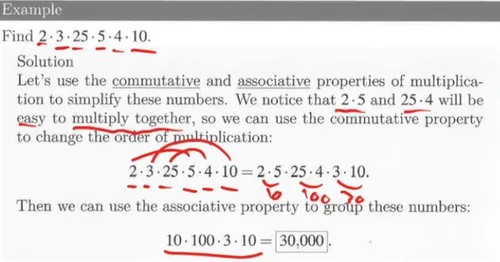
As in an English textbook example, students use the commutative property and the associative property to explain why they group and multiply 2·5 and 25·4 first.
How much time goes to review and to challenge problems depends on how well each student understands Pre-Algebra concepts. Challenge problems start once your child can solve problems from school units on their own and explain the solution.
How students solve them: Students redo problems from their current school unit and go back over concepts they didn't fully learn in earlier grades.
How students solve them: Students solve multi-step reasoning and pattern problems, deciding the order of steps before they start.
Each quiz checks the answer and whether your child can explain why they set up the equation. Quiz results and instructor comments go to parents too. See how parents get progress updates
If you want a clear picture of the unit your child is on and how well they read English word problems, they can take a diagnostic assessment.
What to settle · What we'll go over in consultation
*Hover over or tap a card to see the details and its link.
Let us know which unit your child is studying and what trips them up in English word problems, and we'll choose together what they start with.