CourseG8–9 Write Lab
- What you'll find
- The previous level, where your child compares several English sources and picks evidence for analytical essays


Your child finds evidence in English academic papers and articles, writes academic essays and research papers, and prepares Common App essays.
Your child's instructor corrects each piece, and your child rewrites it.
We look at the piece your child is preparing, their English skills, and their diagnostic results to decide whether they should start at this level.
Whether your child is working on a school essay assignment, a research paper, or a college application essay right now.
Whether your child can read several English sources, compare them, and pick evidence that fits a claim.
Whether grammar mistakes blur the meaning when your child puts ideas into English sentences.
The Common App is a shared application many US colleges use.
| Type of writing | What it says | What the evidence comes from |
|---|---|---|
| Academic essay | Your child's own claim on one topic | Evidence and sources chosen by comparing several English sources |
| Research paper | A research question your child sets, and its answer | Evidence and sources found in papers and research materials |
| College application essay (Common App) | The thoughts your child wants to share with colleges | Personal experiences chosen to fit the essay prompt |
Your child reads English sources on social studies and science topics tied to college majors and finds the claims, evidence, and research questions in them.
Social studies
Science
If background knowledge is thin, your child starts with introductory sources in human geography, psychology, economics, history, biology, chemistry, physics, or environmental science.
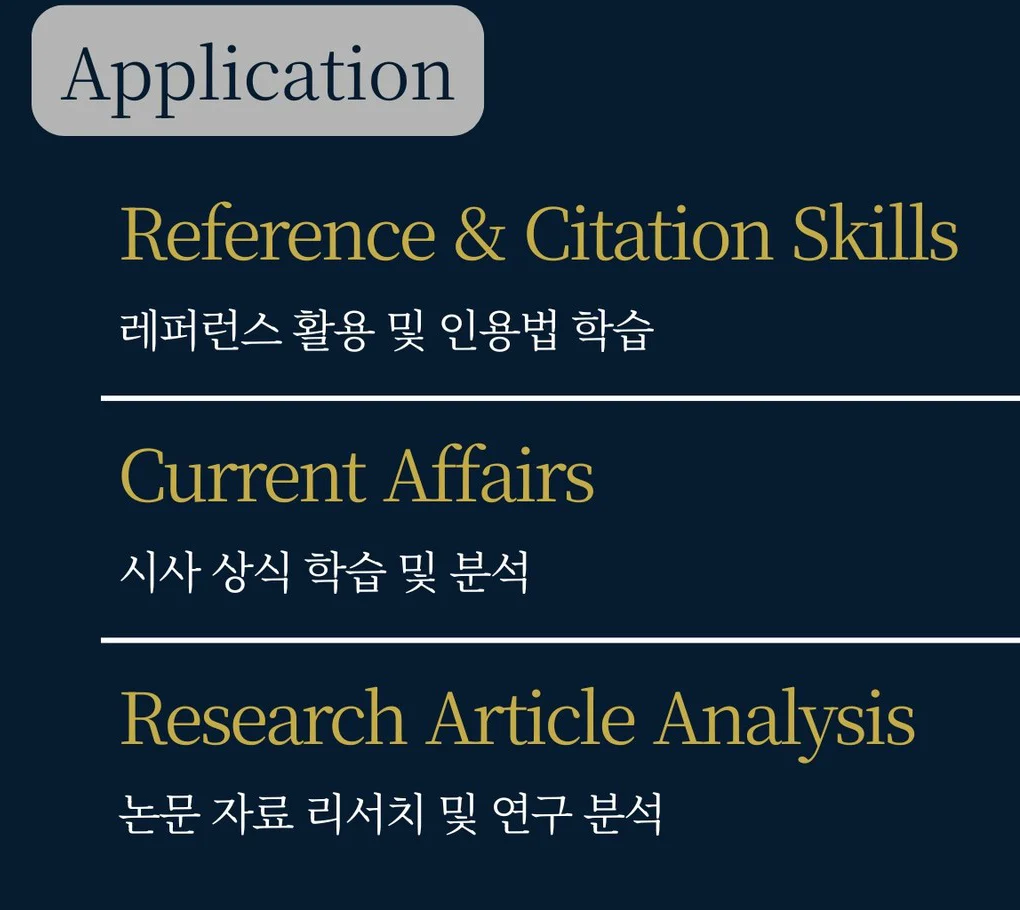
When needed, your child adds practice in citing sources (Reference & Citation Skills), laying out the issues in news articles (Current Affairs), and finding a paper's research question, evidence, and conclusion (Research Article Analysis).
Your child picks out the weak areas in vocabulary and paragraph order that show up in long essays and practices them separately.
Your child builds vocabulary with Analogies, which ask how two words relate, and fill-in-the-blank sentence completion.
Using model essays (Writing Models), your child learns to link paragraphs logically and choose wording that fits the purpose.
Your child uses new grammar in their own sentences and fixes paragraphs that contain mistakes (Paragraph Editing).
At this step, your child: Decides first who will read the piece and what it will argue or show.
At this step, your child: Gathers ideas with brainstorming and mind maps, then outlines the order to write them in.
At this step, your child: Sets a structure for the piece they're writing (an academic essay, research paper, or application essay) and writes an English draft.
At this step, your child: Revises and rewrites the piece using their instructor's written corrections.
Your child takes a quiz every class, an end-of-month assessment, and a quarterly achievement assessment, and we share the results with you regularly. Finished English essays go into a portfolio that shows what has changed and what still needs work. See how parents get progress updates
Whether the claim fits the purpose of the piece and holds from start to finish.
Whether the evidence actually supports the claim and every quoted source is cited.
Whether paragraphs follow a natural order and vocabulary and grammar are accurate.
We choose textbooks from CGP English, Cambridge Academic Writing Skills, Writer’s Choice, Daily Paragraph Editing, and Analogies materials to fit your child's sentence and paragraph level and the piece they're preparing.
Your child rewrites what they wrote in class, following the written corrections. They also practice reading and vocabulary.
Extra English writing outside regular classes, with in-depth written corrections. We'll confirm in consultation whether it's offered now.
*Hover over or tap a card to see the details and its link.
Let us know what your child is preparing to write, and we'll decide together where to start.