
CourseG6–7 Write Lab
- What you'll find
- The previous level, where your child links a claim, reasons, and evidence into paragraphs in an essay


Your child compares several English sources on the same topic, picks evidence, and argues their own position in English analytical essays.
Your child also reads news articles and research writing and learns to quote and cite sources.
This level fits students who write English essays with a claim and evidence but need practice comparing several sources to choose evidence.
The starting level is based on the diagnostic results.
Whether your child understands English sources and can tell how their viewpoints differ.
Whether the evidence your child picks actually supports their claim.
Which needs work first: analysis, evidence, or essay structure.
In grades 6–7, students pull only the information that supports their claim from English sources. In grades 8–9, your child first compares what each source argues, then picks reliable evidence from among them to support their own claim.
Your child finds English sources on the topic and checks whether they're reliable. They keep only what supports their claim and pull ideas from several sources together under their own point of view.
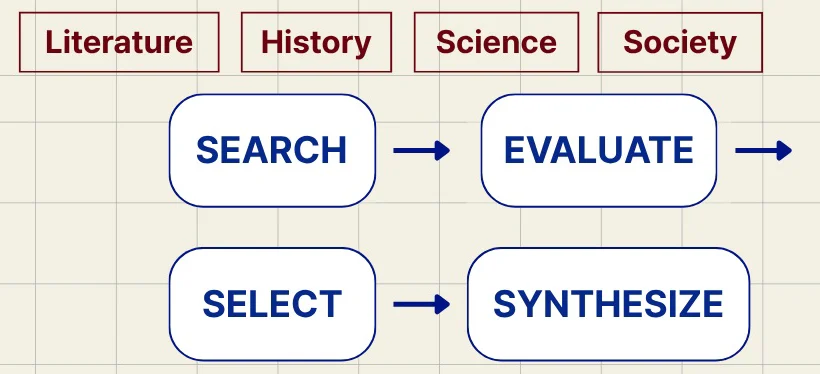
Your child reads English sources, news articles, and research writing on social studies and science, and quotes them as evidence in their own writing.
Social studies
Science
Your child keeps source material separate from their own ideas and notes which source it came from.
Your child compares the issues and viewpoints in news articles and picks evidence for their own claim.
Your child finds the research question, evidence, and conclusion in research articles and uses them as evidence in their own writing.
Your child picks out the weak spots in vocabulary, grammar, and paragraph order that show up in their analytical essays and practices them separately.
Your child learns the words analytical writing needs through word-relationship questions (Analogies) and sentence completion.
Your child studies model essays (Writing Models) to see how several viewpoints and pieces of evidence are ordered.
Your child uses new grammar in their own sentences and finds and fixes grammar errors in paragraphs (Paragraph Editing).
At this step, your child: Decides the question the essay answers and who will read it, then picks English sources to use as evidence.
At this step, your child: Maps out ideas from the sources with a mind map and decides how the essay is structured.
At this step, your child: Picks a form that fits the purpose, such as explaining or persuading, and writes a draft with evidence.
At this step, your child: Fixes content, logic, and sentence errors using the instructor's corrections, then rewrites.
There's a quiz every class, an end-of-month assessment, and a quarterly achievement assessment. Rewritten essays go into your child's portfolio. See how parents get progress updates
Whether the essay answers the question and your child's own claim comes through clearly.
Whether the evidence supports the claim and source material is kept apart from your child's own ideas.
Whether paragraphs follow sound logic, quotes are handled well, and vocabulary and grammar are correct.
Textbooks are chosen from CGP English, Cambridge Academic Writing Skills, Writer’s Choice, Daily Paragraph Editing, and Analogies materials to match your child's level and goals.
Your child rewrites what they wrote in class, following the written corrections. They also practice reading and vocabulary.
More English writing outside regular classes, with in-depth written corrections. We'll tell you in consultation whether it's available.
*Hover over or tap a card to see the details and its link.
We'll look at your child's recent English writing and school assignments and pick a starting level with you.