

SCAT Prep for G1–6
Children in grades 1–6 prepare for the Quantitative (math) and Verbal (vocabulary reasoning) sections of the SCAT, a test students take when preparing for CTY gifted camps.
They learn the concepts and question types first, then take timed practice tests.
What your child learns in each grade
- Course: Lower course
Grades and the SCAT level they prepare for: Students in grades 1–3 prepare for the SCAT Elementary–Intermediate levels.
- Course: Upper course
Grades and the SCAT level they prepare for: Students in grades 4–6 prepare for the SCAT Intermediate–Advanced levels.
Your child's course depends more on the SCAT level they'll take than on their grade.
Quantitative: the math areas your child covers
In the Quantitative section, students use math concepts to reason their way through problems.
- Course: Lower
Math areas your child studies: Numbers, quantity, algebra, statistics, probability, challenge problems
- Course: Upper
Math areas your child studies: Geometry, numbers and quantity, algebra, functions, statistics and probability, challenge problems
Solving one problem more than one way
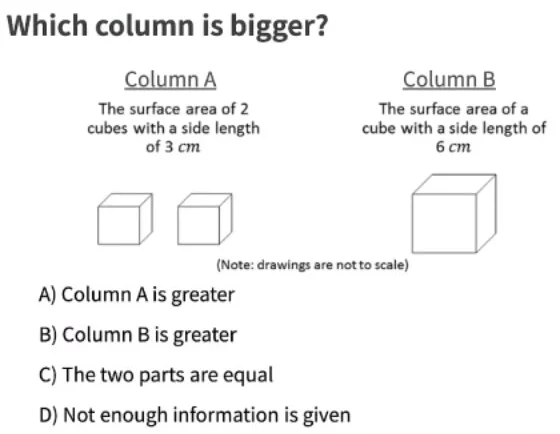
Students compare the surface area of two cubes with 3 cm sides and one cube with 6 cm sides in two ways: by calculating each directly, and by proportion ("double the length, four times the area").
Verbal: the word relationships your child learns
In the Verbal section, students figure out how two words are related and use that relationship to reason out the answer.
- Relationship type: Antonyms
How the two words are related: Two words with opposite meanings
- Relationship type: Synonyms
How the two words are related: Two words with similar meanings
- Relationship type: Part-Whole
How the two words are related: A part and the whole it belongs to
- Relationship type: Intensity
How the two words are related: Two words with similar meanings that differ in degree
- Relationship type: Location
How the two words are related: An object and the place where it's found
- Relationship type: Categorical
How the two words are related: An item and the category it belongs to
- Relationship type: Cause and Effect
How the two words are related: A cause and its result
- Relationship type: Object and Purpose
How the two words are related: An object and what it's used for
- Relationship type: Characteristics
How the two words are related: Something and one of its features
- Relationship type: Terms
How the two words are related: Two words connected to a specific term
Concepts first, then timed practice tests
Quantitative and Verbal classes follow the same steps.
- Step: Learn the concept
At this step, your child: Learns one math area or one word-relationship type.
- Step: Practice question types
At this step, your child: Solves problems similar to past test questions, using more than one method.
- Step: Take a timed practice test
At this step, your child: Takes a practice test against the clock, just like the real test.
- Step: Go over the graded test
At this step, your child: Listens to the explanations after grading and writes up the problems they got wrong.
Sample concept lesson: triangular prisms
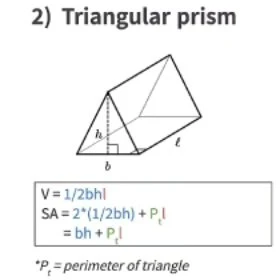
To find the lateral area of a triangular prism, add the areas of its three rectangular faces. Or unfold the sides and find it in one step: (perimeter of the base) × (height).
Homework and tests
- Type: Homework
What your child works on: Reviewing the concepts and vocabulary from class, redoing problems by type, and writing up the ones they got wrong
- Type: Review test
What your child works on: Checking the concepts from the previous class and solving problems of the most common types
- Type: Vocabulary test
What your child works on: Checking that must-know words and terms are memorized, and going back over words from earlier classes
- Type: Cumulative practice test
What your child works on: Taking a full practice test on everything covered so far, midway through and at the end of the course
Plan your child's SCAT prep
Tell us your child's grade and the SCAT level they plan to take. We'll show you which classes they can join right now.