
CourseDeveloping (G1–3)
- What you'll find
- For a child ready to read an easy chapter book all the way through on their own

Your child reads English books with more complex plots and richer vocabulary, then writes and debates using evidence from the book.
Working through a book like Restart over several activities, they look closely at how characters change and the conflicts they face.
This is the next level for a child who can now read easy chapter books on their own. If that's still hard, your child starts in G1–3 Book Club.
At the Critical level, students in Grade 7 and up critique fiction and nonfiction and write research papers. See all Book Club levels
G1–3 Developing
G4–6 Independent
Your child writes in English using evidence from the book plus information they look up on their own.
How it works
In Gordon Korman's Restart, the main character loses his memory and changes as he discovers who he used to be.
At this step, your child: Watches a TED talk related to the book's theme and talks about the background knowledge needed to read it.
At this step, your child: Learns key words from the book with their meanings and example sentences, then memorizes and writes them.
At this step, your child: Learns about the author, the genres (Humor, Social Commentary), and the story's setting.
At this step, your child: Finds out who is in the story and what role each character plays.
At this step, your child: Spends 30 minutes of class time reading the book.
At this step, your child: Works with the instructor to put events in the order they happened, and fills in anything they didn't catch.
At this step, your child: Traces how the main character changes and the conflicts he faces, works out what memory loss, injury, and kindness stand for, and spots foreshadowing.
At this step, your child: Sums up the main ideas and questions, then writes a book review with a star rating and a favorite scene.
At this step, your child: After class, records their interpretation in Cornell notes (a page divided into sections), worksheets, and mind maps.
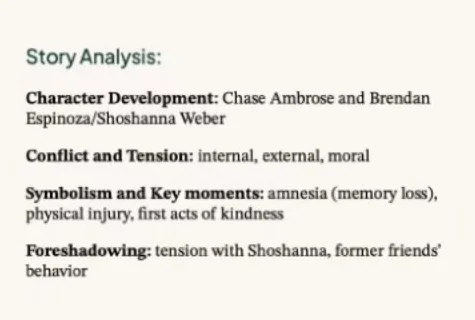
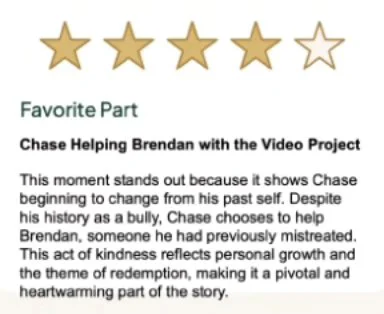
We look at which parts of the book your child points to as evidence when answering questions, and whether they can put their own interpretation into writing.
Book reviews and follow-up assignments are collected in a portfolio, and we send you the instructor's comments and assessment results. See how parents get progress updates
*Hover over or tap a card to see the details and its link.
A diagnostic assessment shows your child's reading and writing level. From there, we decide whether to start at this level and which class to join.