

G1–2 Math Lab
Students build a foundation in numbers and shapes and learn the English math terms for the same concepts.
They learn addition and subtraction, multiplication facts, telling time, and shapes, and redo problems they got wrong until they can solve them without help.
What your child learns in grades 1–2
Units in Korean school
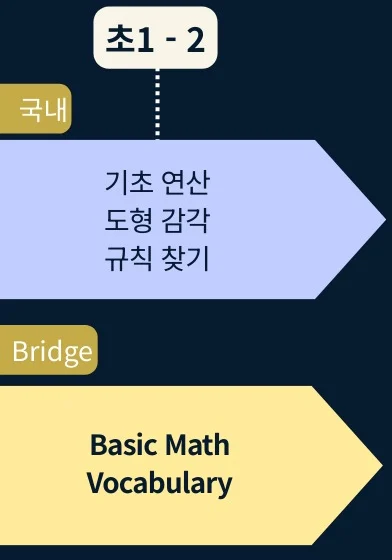
- Grade 1: numbers to 9, 50, and 100; addition and subtraction; telling time and finding patterns; shapes
- Grade 2: three- and four-digit numbers; addition and subtraction; multiplication facts; measuring length; sorting; finding patterns; telling time; tables and graphs; shapes
Similar topics in US and UK curricula at about the same age
- US curriculum, Grade 1: Number Sense, Addition/Subtraction
- US curriculum, Grade 2: Place Value, Patterns
- UK curriculum (KS1): Place Value, Operations
- UK curriculum (KS1): Measurement, Shapes
Schools teach these topics in different orders and grades.
Learning school concepts in English
Students learn the English words for addition, subtraction, shapes, and patterns (Basic Math Vocabulary) so they recognize them in English problems. When it helps, they record the words in an English math dictionary.
Solve independently, then redo mistakes
Units your child can already do alone get a quick check, and units they find hard get more time.
- Step: Review past concepts and learn a new one
At this step, your child: Takes a quiz on the last assignment and the problems they got wrong, then learns the new concept with pictures and examples.
- Step: Solve key problems
At this step, your child: Solves key problems on that day's concept, such as calculations or finding shapes and patterns.
- Step: Explain the solution
At this step, your child: Explains in their own words which information they used, what they found, and how they calculated.
- Step: Find out what went wrong
At this step, your child: Works out with the instructor whether the mistake came from a concept they hadn't fully learned, an English expression they didn't know, or a calculation error.
- Step: Solve again without help
At this step, your child: Solves the corrected problem again on their own to show they understand it.
Challenge problems: SCAT-style and competition problems
Challenge problems go into class when your child is ready for them. If your child is preparing for the SCAT separately, also see the Quantitative class in SCAT Prep for G1–6.
Problem type · How students solve them
- SCAT Quantitative-style problems
- Students solve short reasoning problems that compare numbers and quantities or find patterns, first accurately and then within a time limit.
- Competition problems like Math Kangaroo
- Students use the number, shape, and pattern concepts from school units to solve competition-style problems.
A quiz every class checks what your child learned
The quiz shows whether your child can use that day's concept to solve problems. The problems they got wrong go into their portfolio.
We share these records with you too. See how parents get progress updates
What to settle before your child starts
If you want a clear picture of your child's current level, they can take a diagnostic assessment.
What to settle · What we'll go over in consultation
- English math terms
- How well your child recognizes concepts they already know when they appear in English
- Explaining solutions
- How well your child explains a solution out loud on their own
- Textbooks and homework
- The textbooks and amount of homework that fit your child's level
Explore other grades and courses
*Hover over or tap a card to see the details and its link.
CourseK–G1 Math Lab
- What you'll find
- Children first learn number concepts with manipulatives and pictures before elementary school.
CourseG3–4 Math Lab
- What you'll find
- Students learn fractions, decimals, and basic shapes, then solve school problems again, rewritten as easy English word problems.
CourseG1–6 Math Lab
- What you'll find
- What students learn in each grade, from grades 1–2 through grades 5–6
CourseG1–6 special programs
- What you'll find
- Prep programs for tests and competitions, such as the SCAT and the National Math Achievement Competition




Plan your child's G1–2 Math Lab classes
Tell us which unit your child is studying and which problems they find hard. In the consultation, we'll decide together where to start.